Human Learning with Machine in the Loop - Axe Throwing
 Axe throwing target
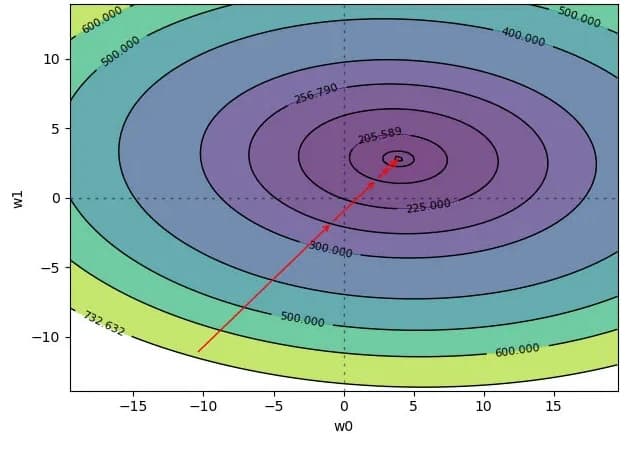 Contour plot of gradient descent
At our 2025 holiday party, I tried axe throwing for the first time. The experience struck me as surprisingly similar to a machine learning problem. The target itself resembles a 2-dimensional gradient descent plot, and hitting it involves adjusting a set of factors: distance to the target, single vs. double-arm throw, starting position, force, movement, and aim, among others. These factors act like the parameters of a machine learning model. After each throw, we adjusted one or more of them based on the result, and our scores improved steadily over time. It was fascinating to watch our brains and bodies learn through this feedback loop, much like how a machine learning algorithm computes a loss and performs gradient descent to update its parameters. The process felt intuitive and natural.
Things got more interesting when the objective shifted from hitting the center to hitting specific score zones. The adjustments we had learned no longer worked, because they were optimized for a single target. We had to start over and recalibrate. This is very similar to train-serving skew in machine learning, where a model trained on one distribution performs poorly when the real-world data looks different. After practicing across different targets, our accuracy broadened. We could aim for any ring on the board, not just the center, similar to how improving training data can help a model generalize better.
This experience suggests that our bodies are natural learners, capable of acquiring new physical skills through trial and error, as long as the goal is clear and the result is measurable. We seem to have an internal optimization process, though likely not gradient descent. What is striking is that this happens largely without conscious analysis. Systematically identifying and examining the variables would probably accelerate the process, but the body finds a way regardless. Whether this kind of embodied learning extends to most human learning experiences is an open question, but axe throwing makes a compelling case for it.